Subscribe to OSXDaily

Subscribe to RSS Subscribe to Twitter Feed Follow on Facebook Subscribe to eMail Updates

Shared on Facebook

Shop at Amazon

Ad

OSXDaily on Facebook

Search interesting

Apple Sold 156 Million iOS Devices in 2011, More Than All Macs Sold in 28 Years

Feb 17, 2012 - 5 Comments

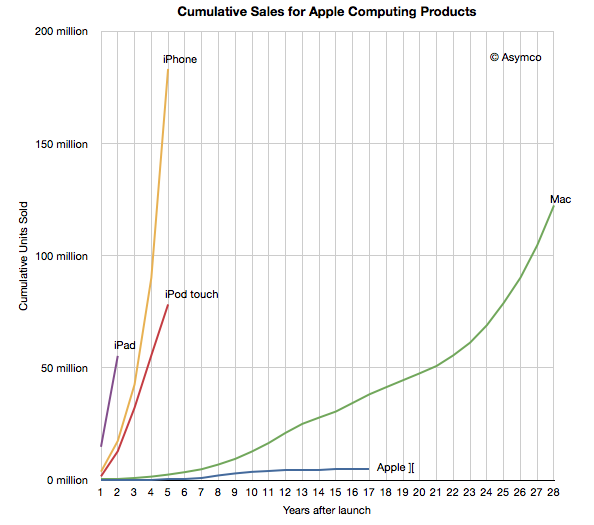
Cumulative Apple Sales: Mac vs iPhone vs iPad vs iPod touch vs Apple II

Growth of iOS, the mobile operating system that powers iPhones, iPads, iPod touch, and Apple TV, is exploding. To put iOS’s success into some context, Asymco crafted the above chart to demonstrate the growth curve relative to years of Apple products on the market. The most staggering observation? Apple sold 156 million iOS devices last year alone, that is over 30 million more units shipped than all 28 years of the Macs existence, where it has sold 122 million computers. Overall, the iOS platform totals over 316 million devices sold in a few short years.

Look to iOS to Understand Mac OS X
If you’re wondering why Apple has been pushing the Mac platform to more closely resemble iOS with the release of OS X Lion and OS X Mountain Lion, this is it. The simplicity, familiarity, and success of iOS is too much to resist. PC’s, and Macs too for that matter, are indeed becoming the “trucks” that Steve Jobs predicted several years ago at D8 2010, becoming greatly outnumbered by the “cars” (in this case, iOS devices). Jobs’ now famous quote from that conversation:

“When we were an agrarian nation, all cars were trucks, because that’s what you needed on the farm. But as vehicles started to be used in the urban centers, cars got more popular. Innovations like automatic transmission and power steering and things that you didn’t care about in a truck as much started to become paramount in cars. … PCs are going to be like trucks. They’re still going to be around, they’re still going to have a lot of value, but they’re going to be used by one out of X people. … I think that we’re embarked on that. Is the next step the iPad? Who knows? Will it happen next year or five years from now or seven years from now? Who knows? But I think we’re headed in that direction.”

The only thing Jobs’ was wrong about was how soon it would happen. As Asymco notes, it only took four years for iOS to overtake OS X.

Simplicity is the Future
None of this means the Mac is dead or dying though, in fact Mac sales are more impressive than ever before, but it does signify the changing roll of computers and how we define a PC. It makes us question who needs what hardware, and for what purpose. Frankly, for many users an iPad – or iPhone – is more than adequate to handle the routine tasks of daily technical life, be it reading or sending emails to browsing the web and listening to music. The Mac (and PC) will certainly still be around for those required to perform more complex tasks, but that market is undoubtedly smaller, and this has already been proven by the runaway success of iOS. As a result, traditional desktop operating systems are evolving towards simplicity. The Mac and PC are ultimately over-engineered and too powerful for the average users technical needs, this helps to explain Apple’s OS X strategy and Microsofts Windows 8 concepts, the power and underlying complexity is still there, but the experience is becoming simpler.

As DaringFireball noted when linking to the Asymco chart, “The lesson: simplicity sells.” If you have any doubts about this or where the industry is going, just look at that chart.

A Brief Look at How Developers Test for iOS Application Compatibility

Feb 12, 2012 - 4 Comments

Lots of iPhones, iPads, iPods, and Androids

Have you ever wondered how an iOS developer tests for application compatibility with the myriad of devices and versions of iOS out there? This picture from developer David Smith gives us an idea, as you can see it takes a lot of hardware. Four iPads, four iPod Touchs, four iPhones, each with a different version of Apple’s mobile OS running (there are even a few non-iOS devices thrown in there for other mobile testing, with two Android phones, a Windows Phone, a Kindle Fire tablet, and a Kindle 4). If you’re wondering why this is necessary, David explains:

I can test anything from iOS 3.1 through iOS 5. The older OS versions are especially helpful to keep around since it is essentially impossible to replicate an issue on iOS 3.X without having a dedicated device kicking around.

This isn’t a fragmentation thing though, this is more a look at how meticulous some iOS developers are for ensuring compatibility for even the most obscure use cases. How necessary it will be for developers to hold onto so many variations of iOS remains to be seen, but the adoption rate of the latest iOS versions looks to accelerate dramatically thanks to Apple bringing the OTA update feature to iOS 5. Of course this also means that those who are lingering on earlier versions of iOS will inevitably begin to miss out on new application features and full compatibility, as anyone using old iPhone and iOS gear can already attest to, and it’s likely that future iOS compatibility labs will include just two devices: an iPhone and an iPad.

For the Mac side of things, it’s also interesting to note that Apple has a Mac compatibility lab at the 1 Infinite Loop campus in Cupertino, California that developers can schedule appointments to use. You can read more about the Mac compatibility lab at Apple.com and explore its vast amount of Macs, but apparently no such lab exists for iOS gear… yet at least.

Make an Active Console Log the Background Wallpaper of iPad or iPhone

Feb 11, 2012 - 7 Comments

WallpaperLog for iOS

A new free app will soon be available on the Cydia store that puts an active Console log as the background wallpaper of your iPhone, iPad, or iPod touch, giving you an overview of all low level events going on with iOS on the device.

WallpaperLog will be a free download on Cydia. Of course, to use and access the Cydia store you will need to have a jailbroken iOS device. Nowadays that isn’t too hard to do and it’s easy to reverse, so if you don’t have jailbroken hardware and are interested in trying this out, backup your iOS device and then use either Absinthe for iOS 5.01. on iPad 2 and iPhone 4S or redsn0w for iOS 5.0.1 on all other iDevices.

It’s not known for certain yet, but it looks like this scrolls through /private/var/log/system.log, as you can see up top on an iPhone (left) and iPad (right), and larger full size screenshots below. Is this useful? Not necessarily for everyone. Is this cool? Yes, absolutely, and the geekier amongst us should get a kick out of it, much like a GeekTool script running atop the background of a Mac OS X desktop,

Read more »

Why Aren’t Apple Products Made in America?

Jan 21, 2012 - 40 Comments

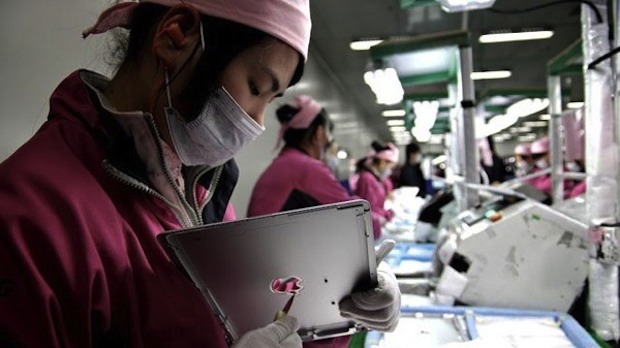
Apple factory

As recently as 2002, most of Apple’s products were manufactured in the USA. What happened? Why is nearly everything, from Macs to iPhones, made in China now? The New York Times provides an in depth report on Apple’s move overseas, and it’s not as simple as you might think.

It isn’t just that workers are cheaper abroad. Rather, Apple’s executives believe the vast scale of overseas factories as well as the flexibility, diligence and industrial skills of foreign workers have so outpaced their American counterparts that “Made in the U.S.A.” is no longer a viable option for most Apple products.

If you enjoyed the “Mr Daisey and the Apple Factory” podcast, you’ll probably enjoy reading this too, as it sheds some light on the business decisions driving factories like Foxconn. Here’s an example on the challenge Apple faced when hiring skilled engineers in the USA vs China:

Apple’s executives had estimated that about 8,700 industrial engineers were needed to oversee and guide the 200,000 assembly-line workers eventually involved in manufacturing iPhones. The company’s analysts had forecast it would take as long as nine months to find that many qualified engineers in the United States. In China, it took 15 days.

The lengthy read also includes several anecdotes about Steve Jobs and Tim Cook, as well as plenty of quotes from other unspecified current and former Apple executives. If you’re interested in Apple and Apple history, don’t miss it.

Read New York Times: How U.S. Lost Out on iPhone Work

Ever Wonder Where Your Apple Hardware Comes From? Listen to “Mr Daisey and the Apple Factory”

Jan 10, 2012 - 4 Comments

Foxconn Factory

Update 3/16/2012: This American Life has now retracted the entire episode because they discovered that Mike Daisey made up significant parts of the story. Yes, Mr Daisey fabricated much of his tale about Foxconn Factories. Shameful.

“Designed by Apple in California. Assembled in China” sits in fine print on the back of virtually any piece of hardware that Apple ships, be it an iPad, iPhone, or MacBook Air. But have you ever wondered about the second part, the Chinese component? Where these devices are being made in some factory far away, and by who? An episode of NPR’s This American Life podcast aims to answer that question with the help of monologuist Mike Daisey, who wondered “Who makes all my crap?” and then traveled to Shenzen China to find out in an episode called “Mr Daisey and the Apple Factory”.

It’s a humbling hour long, separated into two joined parts, and well worth a listen:

Part 1 is described as:

Mike Daisey performs an excerpt that was adapted for radio from his one-man show “The Agony and the Ecstasy of Steve Jobs.” A lifelong Apple superfan, Daisey sees some photos online from the inside of a factory that makes iPhones, starts to wonder about the people working there, and flies to China to meet them. His show restarts a run at New York’s Public Theater later this month. (39 minutes)

Part 2 is described as:

What should we make of what Mike Daisey saw in China? Our staff did weeks of fact checking to corroborate Daisey’s findings. Ira talks with Ian Spaulding, founder and managing director of INFACT Global Partners, which goes into Chinese factories and helps them meet social responsibility standards set by Western companies (Apple’s Supplier Responsibility page is here), and with Nicholas Kristof, columnist for The New York Times who has reported in Asian factories. In the podcast and streaming versions of the program he also speaks with Debby Chan Sze Wan, a project manager at the advocacy group SACOM, Students and Scholars Against Corporate Misbehavior, based in Hong Kong. They’ve put out three reports investigating conditions at Foxconn (October 2010, May 2011, Sept 2011). Each report surveyed over 100 Foxconn workers, and they even had a researcher go undercover and take a job at the Shenzhen plant. (15 minutes)

While this episode focuses on Apple products, Foxconn produces hardware for many other electronics companies including Amazon, Microsoft, Intel, IBM, Nintendo, Dell, Samsung, Sharp, Nokia, Motorola, and countless others, and it’s safe to assume the unflattering descriptions of work conditions and factories goes far beyond Apple.

Young Steve Jobs Gives IBM the Finger

Dec 30, 2011 - 10 Comments

Steve Jobs gives IBM the Finger

This is a classic picture of a young Steve Jobs giving the finger to an IBM sign in 1983, it’s been circulating again after all these years thanks to Macintosh co-creator Andy Hertzfeld who posted the high res copy to Google+. Here’s the text that was posted along with the amusing image:

In memoriam for Steve Jobs as 2011 draws to a close, here’s one more rare photo that illustrates his rebellious spirit. In December 1983, a few weeks before the Mac launch, we made a quick trip to New York City to meet with Newsweek, who was considering doing a cover story on the Mac. The photo was taken spontaneously as we walked around Manhattan by Jean Pigozzi, a wild French jet setter who was hanging out with us at the time. Somehow I ended up with a copy of it. My editor begged me to include it in my book, but I was too timid to ask for permission, especially since IBM was still making CPUs for Apple at the time.

The book is his “Revolution in The Valley: The Insanely Great Story of How the Mac Was Made“, which tells the story of how the original Macintosh was created. That subject was briefly discussed in the recent Steve Jobs biography as well.

The picture demonstrates the competitive nature of Jobs and early Apple, and although the image has been around a while this is the first higher resolution copy to surface. In the early days of Apple, IBM was largely considered the companies biggest competitor and enemy of sorts, as is demonstrated in the Ghostbusters spoof and of course the classic 1984 Superbowl commercial that launched the first Mac.

Apple Spoofs Ghostbusters in Outrageously Cheesy 1984 Sales Video

Dec 29, 2011 - 6 Comments

In 1984, Apple spoofed the classic Ghostbusters song by Ray Parker Jr, and this outrageously cheesy video is the result.

The video apparently played as the introduction to an Apple corporate event held in Hawaii to rally the international sales team. Instead of Ghostbusters, it’s “Blue Busters”, with Blue of course being a reference to Big Blue, or IBM. John Sculley and Steve Wozniak even make appearances in the video, and supposedly Steve Jobs is somewhere in there too as a Ghostbuster along with a few other Apple execs, although I couldn’t identify who was who.

Hilarious find by TheNextWeb, who also found a few more details from a YouTube commenter that happened to be at the event:

I was there in Oct. 1984. This was not an internal ad. I was a 1984 state of the art multimedia slide show with audio by Ray Parker Jr. who sang the original. There were also live dancers on the stage.

This was the opening presentation of the International Sales Meeting that introduced the Lightwriter later renamed Laserwriter.

Apple always used a current movie as a them for the sales meetings. in 1985 it was Back to the Future.

So, anyone found that 1985 video yet?

Apple history at it’s finest, or funniest at least.

Steve Jobs: Billion Dollar Hippy – BBC Documentary [Video]

Dec 17, 2011 - 8 Comments

The recently aired BBC documentary Steve Jobs: Billion Dollar Hippy may have a dumb name, but the show itself is worth a watch for anyone interested in the subject matter. About an hour long, it features classic footage of Steve Jobs, in addition to interviews with a variety of Apple execs and industry leaders, including Steve Wozniak, John Sculley, Andy Hertzfeld, Tim Berners-Lee, Avie Tevanian, and many more names that will be familiar if you follow Apple history or have read the Steve Jobs biography.

The video looks to have been posted to YouTube unofficially, so watch it while you can.

Background Music from the iPhone 4S Commercial

Dec 11, 2011 - 7 Comments

Apple has been airing several iPhone 4S commercials, a few focus on Siri, while others center on iCloud or the new camera. Each ad shares the same background music, and what’s the tunes name? The song is Orchestral – “Goldengrove v2″ by Keith Kenniff, an American composer.

The song is instrumental, contrasting the poppy sound of the song played in the new iPod touch ad or The Beatles classic heard in the recent “Cover” commercial.

Somewhat strangely, Orchestral – “Goldengrove v2″ doesn’t appear to be available for purchase on iTunes, but you can listen to it above, on YouTube below, or directly on the artists Soundcloud page, it’s about 1:30 long.

Thanks for sending this in Stuart
Read more »

iOS Version Code Names Are Labeled After Ski Resorts

Dec 5, 2011 - 4 Comments

iOS versions named after ski resorts

Fitting news as the Northern Hemisphere approaches winter and ski season, it has been discovered that Apple internally identifies iOS versions with code names based on ski resorts. The current list of iOS versions and their mountain code names is printed below, courtesy of AppleInsider:

  • 1.0: Alpine
  • 1.1: Little Bear
  • 2.0: Big Bear
  • 2.1: Sugarbowl
  • 2.2: Timberline
  • 3.0: Kirkwood
  • 3.1: Northstar
  • 3.2: Wildcat
  • 4.0: Apex
  • 4.1: Baker
  • 4.2: Jasper
  • 4.3: Durango
  • 5.0: Telluride
  • 5.1: Hoodoo

There doesn’t appear to be any relation between the popularity of the mountain and the significance of the iOS version, with even some little known ski resorts appearing on the list. Maybe Scott Forstall and the iOS development team are just big fans of snow sports?

Naming iOS versions after mountain resorts is in contrast to Apple’s desktop Mac OS X being code named and marketed with the names of large wild cats, starting with Mac OS X Cheetah (10.0), Puma (10.1), Jaguar (10.2), Panther (10.3), Tiger (10.4), Leopard (10.5), Snow Leopard (10.6), and most recently, Lion (10.7).