
Generate a Random Number with Siri
May 19, 2014 - 6 Comments
 Many iPhone and iPad users know that Siri has a huge range of capabilities surrounding specific actions, but fewer know that Siri can also serve more obscure functions, like generating a random number for you. This is handled through Siri’s data connection through Wolfram Alpha, and it’s effective at truly randomizing integers similar to the virtual assistants ability to create a random password. So, the next time you need a random number for any particular purpose, pull out your iOS device and summon Siri to ask for such a thing.
By Paul Horowitz - iPad, iPhone, Tips & Tricks - 6 Comments
 Those of us who have been using an iPhone or iPad for a while have likely acquired a sizable amount of iOS apps through purchases, downloads,
 Mac users who primarily browse the web with Safari will eventually notice the “Flash out-of-date” message appearing somewhere in the browser. This happens because the Mac will intentionally disable the Flash player plugin when it has become outdated, preventing any potential security breaches from occurring. As you probably guessed, this just means you need to update the Adobe Flash Player plugin to the latest version, but many users have done just that (or think they have) and still find the “Flash out-of-date” message appearing all over Safari and around the web. That’s what we’re aiming to address here, properly installing the latest version of Flash to get the plugin working again in Safari and to resolve that error message.
 Apple has released iTunes 11.2.1, an update that, curiously, resolves the issue where some users encountered their

 Being able to quickly access
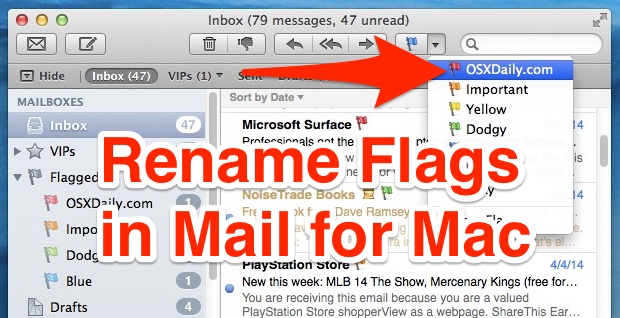
 The Mail app on our iPhones and iPads downloads and stores emails and attachments into iOS, which makes for easy searching and retrieval of past emails. For most users this is no big deal and the convenience overrides any potential issues, but some users who send and receive a lot of attachments or tons of email may find during

 Boot Camp allows you to dual-boot between a Windows partition and Mac OS X on a Mac. Dual booting multiple OS’s is incredibly useful and has plenty of purposes, but if you decide you no longer need to run Windows on a Mac you’ll probably want to remove the Windows Boot Camp partition so that you can recover the drive space. Some users wind up formatting the Mac drive and restoring from a Time Machine backup, but that’s not necessary, instead you can choose to remove only the Windows Boot Camp partition while preserving Mac OS X untouched.