If you purchase an app from the iTunes App Store, as long as you use the same iTunes account again, all subsequent downloads of that app are free. This means that if you bought an iOS app for an iPod touch, but you just got a new iPhone, iPad, or Mac you do not need to buy the same app again.
Did you know that your Mac has a built-in FTP & FTPS client? You don’t need to download any additional software or apps to connect to FTP sites from Mac OS X, instead you can connect to remote servers directly from your desktop by using an excellent and little known feature. If you’ve never used the Mac FTP tools before, you will find them incredibly simple and quite familiar, because the connection utilities and server browsing are much like navigating through the normal Mac desktop. Let’s get started.
Late last year Apple said the white iPhone 4 was coming in “Spring 2011” but it looks like the launch of the White iPhone 4 is just around the corner. Read more »
If you’re trying to remember an exact command you executed via the Terminal but can’t quite come up with it, you can query your command line history to discover old commands that have been run or executed in the past.
This trick to find and retrieve prior commands executed in the command line works on Mac OS, Mac OS X, as well as linux and other unix operating systems too. Anything with a standard history command can use this trick to retrieve prior commands, making it an invaluable tool for systems administrators and command line users.
Need to silence an iPhone phone call and hush the ringing quickly? If you’re getting an incoming call and you want to quickly silence the iPhone, just hit either of the volume buttons to instantly silence the ringer.
Pressing a volume button during an incoming phone call will immediately mute the iPhone and stop the ringer from sounding any alert or vibration, but it does not send the call to voicemail so the caller won’t have any idea that you aren’t listening to the phone ring.
GreenPois0n RC5 3 has been released for Mac OS X, this is the third update to RC5 for Mac that provides an untethered jailbreak for iOS 4.2.1. RC5 3 includes several significant bug fixes in addition to native Mac OS X 10.6 and 10.5 support.
GreenPois0n RC5 for Windows has been released which allows users to perform an untethered jailbreak on iOS 4.2.1 devices. This release works to jailbreak all iPhone, iPod touch, iPad models, as well as Apple TV2.
If you like older Apple equipment, you’ll love this picture sent in via Flickr. From Apple II’s to Bondi Blue iMacs, this collection of retro Mac hardware definitely has some bragging rights.
AT&T has released a new iPhone commercial that jabs at the Verizon network. The commercial features a guy making last minute dinner reservations on his iPhone while chatting on the phone to his partner. The point of the commercial is to brag about AT&T’s ability to use voice and data concurrently, ending with “only AT&T’s network lets your iPhone talk and surf at the same time.”
It’s kind of funny watching the two major US iPhone carriers fight it out over commercials, and Apple is happily caught in the middle here since the product being sold is always the iPhone, the competition is between service.
GreenPois0n RC5 2 has been released, the update to 1.0 RC5 aims to fix an initialization error that some users reported. The “initialized” error seemed to be somewhat random, but it prevented the GreenPois0n jailbreak from continuing on the effected devices.
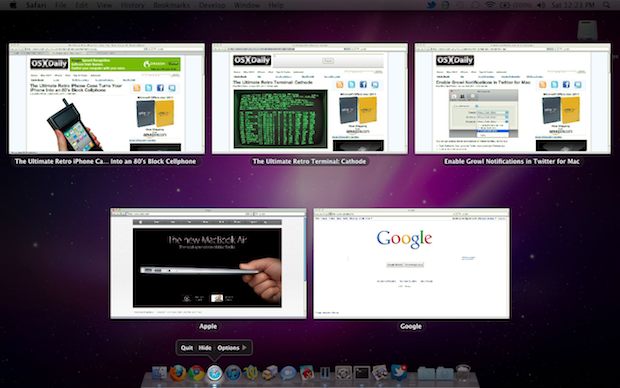
If you click and hold on any open applications Dock icon, you will launch Expose for just that app and it’s corresponding windows.
You can also access this app-specific Expose with the F10 key (Function+F10 on newer Mac models and keyboards), I’ve used this trick for a long time to quickly switch between windows in a given app and once you get in the habit of doing so it’s hard to go back.
There’s a new commercial for the Verizon iPhone that jabs indirectly at AT&T: “It’s beautiful, it’s intelligent, even genius. But does your network, work?” that question is of course answered by the ubiquitous Verizon Guy; “Yes, I can hear you now.”
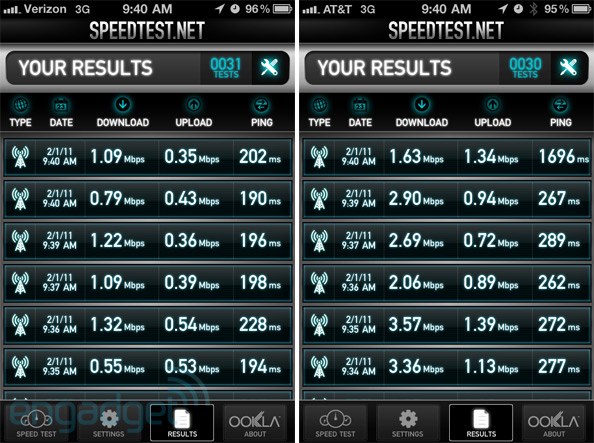
The takeaway from all this Verizon vs AT&T stuff is this: you can make clearer phone calls with Verizon, but AT&T’s 3G speed is faster.
The GreenPois0n untethered jailbreak for iOS 4.2.1 has been released and it allows you to jailbreak any iOS 4.2.1 device completely untethered. This will work on the iPhone, iPod touch, and iPad.
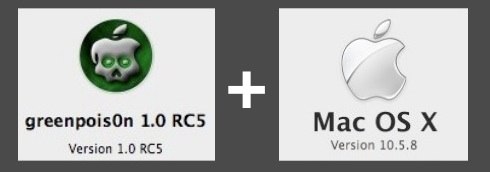
How to Jailbreak iOS 4.2.1 Untethered with GreenPois0n 1.0 RC5
Backup your iPhone or iOS device before proceeding. Do not use this jailbreak if you rely on a carrier unlock!
Connect the iOS device to the computer with GreenPois0n 1.0 RC5
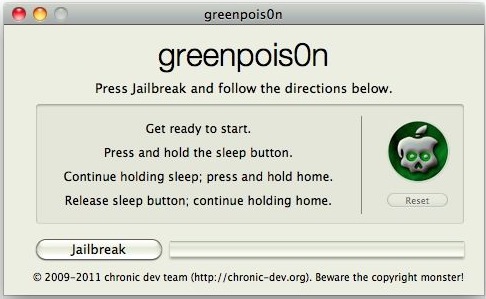
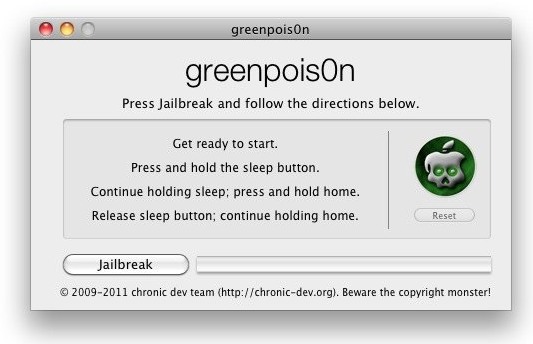
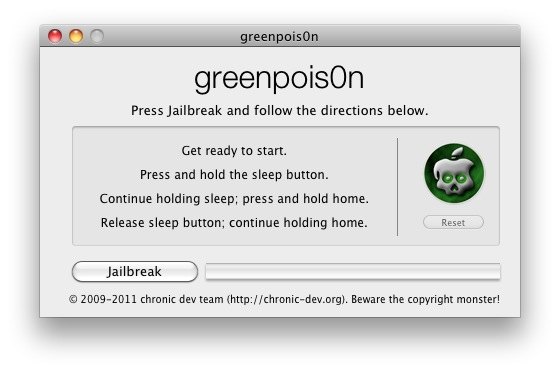
Launch GreenPois0n and click on “Jailbreak”
Follow the onscreen instructions and counter carefully, this lets you know how long to hold buttons
Press and hold the sleep button for 2 seconds
Continue holding sleep, press and hold home for 10 seconds
Release sleep button, continue holding home button
Your iOS device should now be in DFU mode and it is ready for the jailbreak
Click on “Jailbreak” and let the exploit install
After your device has been jailbroken, go to your iPhone and look for the green “Loader” icon and launch this to install Cydia
GreenPois0n 1.0 RC5 includes the ability to have custom animated boot logos. This version of GreenPois0n is superior to the latest Redsn0w release because it does not require developer saved SHSH blobs of 4.2b3.
Troubleshooting: If you are having problems getting Loader to download and install Cydia after using GreenPois0n RC5 jailbreak, the servers may be overloaded. In this case try again, or you can do the following:
The latest version of Greenpois0n has been released for download, it offers an untethered jailbreak for iOS 4.2.1. The Mac and Windows release come as GreenPois0n 1.0 RC5, with a Linux version due out soon.
Download GreenPois0n Untethered Jailbreak for iOS 4.2.1
If the initial download link does not work, be sure to try one of the mirrors.
As usual, backup your iPhone before proceeding. If you are currently using a tethered jailbreak like redsn0w, you should restore before jailbreaking again with GreenPois0n 1.0 RC5.
Update: For those encountering a problem where the app stalls on “initialized”, you can download GreenPois0n RC5 2 to resolve this.
Update 2: The Windows version of GreenPois0n Untethered will be released tomorrow or the next day, according to p0sixninja. We will update download links for all versions of GreenPois0n as they are available.
Update 3:GreenPois0n RC5 for Windows has been released. It supports the untethered jailbreak for iPhone, iPad, iPod touch, and Apple TV2, running iOS 4.2.1.
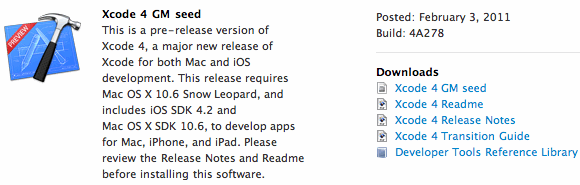
Apple has released Xcode 4 GM for those who are enrolled in the Mac and iOS development programs. Xcode 4 is a significant update to the Xcode IDE and includes both iOS SDK 4.2 and Mac OS X SDK 10.6.
According to early reports, XCode 4 GM allows developers to submit iOS and Mac apps directly to their respective App Stores. Other improvements include:
Xcode 4 has a brand new, single window interface for all major workflows
Interface Builder is now integrated within the main Xcode IDE
Assistant shows a paired editor with complementary files (headers, UI controllers, etc.)
Fix-it highlights code where an error is detected, as you type, and can even fix it for you
Version editor shows a live comparison through SCM history, using Git or Subversion
LLVM compiler 2.0 includes full support for C, Objective-C, and now C++
LLDB debugger is faster, and uses less memory than the GDB debugging engine
– see notes below on how to enable the LLVM compiler or LLDB debugger
Instruments adds System Trace, and new iOS instruments including OpenGL ES
XCode 4 requires Mac OS X 10.6 to install, if you are a developer you can get the GM release from Apple’s Developer Center.
Update: That came and went quick, Xcode 4 GM build has now been pulled.
Update 2: Xcode 4 GM is back again for downloading from Apple’s Dev Center.
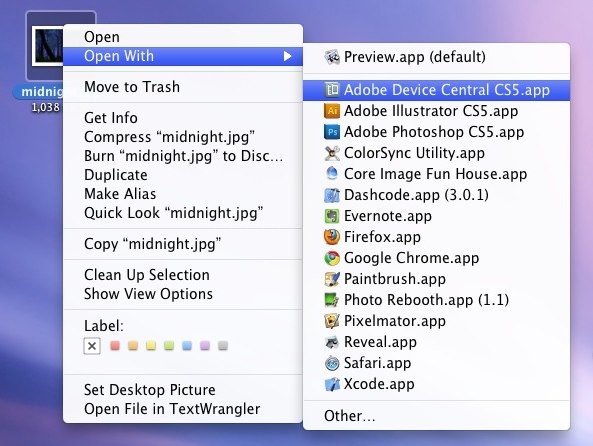
The more apps you install on your Mac, the more bloated your “Open With” menu gets. Some apps that are completely unrelated to the file type may show up in the “Open With” menu and just serve to clutter your choices. This is annoying, so lets restore the menu to what it should have.
How to clear the “Open With” menu in Mac OS X
You need to get to ~/Library/Preferences/, you can get there with the Go to Folder (Command+Shift+G) option, or by the instructions below:
Open your Home directory
Open the “Library” folder
Find and open the “Preferences” folder
Once you are in the proper folder:
Locate “com.apple.LaunchServices.plist”
Rename “com.apple.LaunchServices.plist” to “com.apple.LaunchServices-backup.plist” or just relocate it elsewhere (you can delete it completely if you aren’t worried about backups)
Now the next time you use the “Open With” menu it will only include current applications in the list. You may need to log in and out of your user account for changes to take effect.
Another issue, though it’s completely separate than cleaning out the entire menu, is when repeat entries of apps are contained within the Open With submenu. If you want to ditch those duplicates, you’ll need to head to the Terminal and you can read how to go about removing duplicate entries from the Open With menu here.
Wondering how fast data transfer is on the Verizon iPhone 4 versus the AT&T iPhone 4? If you’re concerned about maximum 3G transfer speeds, AT&T may be your network. Read more »

 If you purchase an app from the iTunes App Store, as long as you use the same iTunes account again, all subsequent downloads of that app are free. This means that if you bought an iOS app for an iPod touch, but you just got a new iPhone, iPad, or Mac you do not need to buy the same app again.
  Did you know that your Mac has a built-in FTP & FTPS client? You don’t need to download any additional software or apps to connect to FTP sites from