Want to transfer photos from a digital camera to iPhone? You can easily import photos and video from a digital camera or SD card to an iPhone with the help of an appropriate adapter and the super simple iOS Photos import procedure. This tutorial will walk through the steps to copy images and media from an SD card or camera to an iOS device.
Apple has released a supplemental update to MacOS Mojave for select 2018 MacBook Pro 15″ models. The update apparently addresses a firmware issue with the T2 security chip on those particular computers.
Labeled as “macOS Mojave 10.14.5 Supplemental Update for MacBook Pro”, the software update is specific to MacBook Pro 15″ models with the T2 security chip and is separate from the wider macOS 10.14.5 release that is available for all Mojave compatible Macs.
The supplemental update is not available for any other Mac models.
The iOS keyboard defaults to having a setting that automatically capitalizes a new word that is typed after the end of a sentence. This auto-capitalization applies to the first character of any word typed after a period, and while many iPhone and iPad users love this feature since it can make typing faster on iOS keyboards, some users may not like it.
If you want to disable the automatic capitalization of words after a period in iOS, read on to learn how to do do so.
Note the auto-capitalization feature is different from the auto-correct feature on iPhone and iPad, though many users confuse the two. In fact, they two different features controlled by two different settings. If you are looking to turn off auto-correct in iOS then blah.asdlfasdl
Apple quietly updated the MacBook Pro line today via press release, offering faster processors and improved speeds at up to a 40% increase in performance. Apple also told select members of the press that the updated MacBook Pros include improved keyboard materials that aim to reduce keyboard failures.
Additionally in regards to keyboards, Apple is expanding their keyboard service repair program for all butterfly design keyboard equipped MacBook Pro, MacBook Air, and MacBook computers.
Want to toggle Do Not Disturb mode on the Mac with a keyboard shortcut? You can easily enable a custom keyboard shortcut to turn on or off Do Not Disturb mode in MacOS, and we’ll show you how to set it up.
Do Not Disturb mode on the Mac is one of the best features you can use if you want to focus on a task, and not be distracted by the myriad endless notifications and alerts that pop up on the Mac. Enabling and disabling the feature with a keyboard shortcut offers a quick way to toggle the feature off or on as quick as possible and at any time.
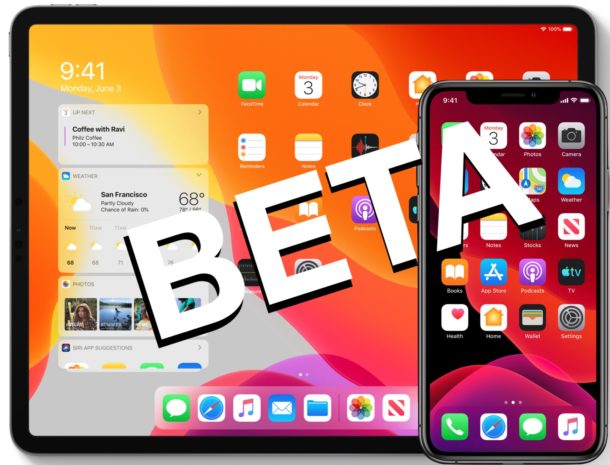
Apple has issued the second beta version of iOS 12.4 to users enrolled in the iPhone and iPad beta testing programs. Both developer beta and public beta builds are available.
The data contained within Health app on iPhone can be saved and exported for other uses. Perhaps you want to export Health app data to use in another health or fitness app, importing it to elsewhere, or maybe you want to use the raw Health data for your own purposes.
Exporting Health data from iPhone results in a zip archive that contains the raw data as gathered by Health app in XML format. This exported Health data will include any data stored or gathered by the Health app and any associated devices, including any Medical ID data, the native iPhone step counter and distance tracker, any data from an Apple Watch, and any data gathered from any third party devices that are syncing to Health app, like a smart scale or blood pressure monitor. Read no to learn how to export Health data from iPhone.
If you use Spotify for streaming music, over time you may discover the Spotify app increases local cache storage, which can sometimes grow quite large. These audio cache files can make the Spotify app appear to take up a lot of storage space on an iPhone or iPad. But fortunately Spotify offers a simple functionality hidden within the app that allows you to easily delete all local cache from Spotify, which is a very helpful tool to free up some storage space.
The Gmail web email client is very fancy, but some Gmail users may wish to use the much more simplified Basic HTML mode for Gmail. Basic HTML Gmail strips away the fancy actions, features, and functions as well as JavaScript from the default Gmail web view, turning Gmail.com into a much more simplified webmail experience.
The main advantage to using Gmail in Basic HTML mode is that it’s stripped down considerably and thus very fast loading with lower resource requirements, so if you’re on a lower bandwidth internet connection it can make using Gmail a better experience. Of course there are other reasons users may want to use Gmail in HTML mode as well, including for improved compatibility with specific web browsers, for using Gmail with notably older browsers or older operating systems, to simplify the interface appearance to be closer to old-fashioned Gmail, or to avoid JavaScript altogether, amongst many other reasons.
You can switch Gmail to Basic HTML view and back to Standard Gmail View at any time, this article will show you how to do that.
If you’re a Mac user who relies on iCloud Drive for data syncing and cloud storage, you might appreciate knowing that you can enable an optional iCloud Status indicator in the Mac Finder.
The iCloud Status indicators in Finder can tell you if a file or folder is only in iCloud, on the local Mac, ineligible for iCloud, waiting to upload, transferring, and more. Note these iCloud Status indicators are different from progress indicators, though you can also check the progress of iCloud file uploads and downloads in Mac OS if desired.
If you use a hardware keyboard with iPad you may have noticed that auto-correct and some other keyboard settings that applied to iOS are no longer taking effect. This is because the iPad has separate settings for the software keyboard onscreen, and a hardware keyboard if one is connected to the iPad, and thus disabling autocorrect in iOS for the screen keyboard won’t carry over to the hardware keyboard, like a Smart Keyboard, iPad keyboard case, or external keyboard. Thus, to turn off autocorrection on iPad with a physical keyboard, you must adjust a separate setting.
We’ll show you how to disable auto-correction on iPad when using a hardware keyboard with the tablet.
Apple has released the first beta version of iOS 12.4 and macOS Mojave 10.14.6 to users enrolled in the eligible beta testing programs.
The release of iOS 12.4 beta 1 and macOS 10.14.6 beta 1 comes just a day after the wide public release of the iOS 12.3 update for iPhone and iPad users, and macOS 10.14.5 update for Mac users.
Let’s say you’re in a Messages conversation and you want to quickly send someone your current location from iPhone. In this scenario you might go to the Messages conversations Info / Details section and use the “Share Current Location” feature, but did you know there’s an even faster way to instantly share your current location from the iPhone Messages app that can be accessed by typing alone?
This is about as easy as it gets, and sending someone your current location this way is initiated entirely by typing a very short phrase on the iPhone within the Messages app.
Apple has released MacOS Mojave 10.14.5 to all Mac users running the Mojave operating system. The macOS 10.14.5 update includes several bug fixes along with AirPlay 2 support for AirPlay 2 compatible smart TVs.
Mac users running MacOS High Sierra or Sierra will also find a Security Update available for those prior system software releases.
Apple has released iOS 12.3 for iPhone and iPad. The final stable version of iOS 12.3 includes a handful of bug fixes, along with AirPlay 2 support and a redesigned TV app.
Separately, Apple has released macOS Mojave 10.14.5 for Mac, along with watchOS 5.2.1 for Apple Watch, tvOS 12.3 for Apple TV.
Rarely, you may attempt to unzip a zip archive and come across an error that states “End-of-central-directory signature not found. Either this file is not a zipfile, or it constitutes one disk of a multi-part archive. In the latter case the central directory and zipfile comment will be found on the last disk(s) of this archive.” This tutorial will attempt to resolve the zip file “End of central directory signature not found” errors when attempting to decompress an archive.
For a variety of reasons, an Apple ID may become disabled. Usually this corresponds with an obvious message like “Apple ID Disabled” or “This Apple ID has been disabled for security reasons” or some other notification that you are unable to sign in to the locked Apple ID because it has been disabled. This can be seen when trying to login to an Apple ID on iPhone, iPad, Mac, iCloud.com, or any other place you might attempt to login to an Apple ID. Obviously a disabled Apple ID is a big deal because nearly the entire Apple universe is accessed through an Apple ID, including iCloud, Music, iTunes, App Store, and much more, so you’ll understandably want to regain access to an Apple ID to re-enable it and fix the issue.
If your Apple ID is disabled and you having trouble logging into the account, read on to learn how to troubleshoot and resolve this problem. We’ll cover three different approaches to fix a disabled Apple ID.