OS X Yosemite runs great on most new Macs, but some older models may experience some sluggishness or stuttering from time to time. The reason for that feeling of reduced performance can be due to a variety of issues, and most of them are really easy to resolve with surprisingly little effort.
Dark Mode impacts the appearance of the Dock and Menu Bar in Mac OS X, turning both from their grey on white defaults to a higher contrast white text against black background dark alternative. The effect is sort of iOS-like, but it also makes a great addition to the Increase Contrast feature on a Mac with the latest MacOS X version. Typically to enable Dark menu and Dock Mode on a Mac you have to go into the System Preferences and toggle a switch, but another option is to enable a hidden keyboard shortcut instead, as we’ll show you how to do.
Continuity and Handoff are two great features of OS X Yosemite and iOS 8 that allow an iPhone or iPad to ‘handoff’ an application, like a half-written email, over to the Mac to be completed in the Mac Mail app. It’s one of the major reasons for iOS and Mac users to upgrade to OS X Yosemite and it greatly improves productivity, but not all Macs support the feature. The Continuity Activation Tool changes that, it’s a third party utility that brings Handoff and Continuity support to some Macs that aren’t supposed to have the feature.
The iTunes sidebar has been a part of the media players functionality since the earliest days of the app, allowing users to quickly navigate around iTunes and their media, and also easily transfer things like music and movies to their iPhones, iPads, and iPods. The latest version of iTunes 12 has a different take on things though, and the interface has changed considerably by removing the sidebar and eliminating the option to show the sidebar from the View menu.
It turns out there is a way to show a sidebar in iTunes 12, however. Read more »
The revised interface in modern MacOS versions including macOS Monterey, macOS Big Sur, MacOS Catalina, macOS Mojave, High Sierra, Sierra, OS X El Capitan, and OS X Yosemite makes heavy use of transparencies, flatness, white space, smaller and narrow fonts, and a dramatic lack of contrast with neutral shades of grey used for most text and many onscreen elements. Combined with the new system font choice of San Francisco or Helvetica Neue (the same font from iOS), the overall look of modern Mac OS is beautifully fancy on Macs with Retina displays, but the ensemble doesn’t always look so great on Macs with normal screens, where the thinness and lack of contrast just ends up looking blurry. Additionally, some users find the Mac interfaces lack of contrast to be challenging to read and interpret.
For Mac users who have updated to OS X Yosemite and found it to be unbearable for whatever reason, you’ll be pleased to discover that downgrading back to OS X Mavericks may be a possibility for you. This is not specifically recommended, but if you’re absolutely set on reverting from Yosemite to the prior version of OS X running on your Mac, you can likely do so. We’re going to cover downgrading to Mavericks, but technically this process would work to get back to other versions of OS X too.
Mac users who require Java and who have installed OS X Yosemite may have discovered that a prior version of Java is no longer functioning under OS X 10.10, and that older installers don’t work to install Java in Yosemite. Additionally, a fresh install of Yosemite does not include Java at all. If your Mac running OS X Yosemite needs Java for application compatibility, online banking, or any of the myriad of other reasons, you can manually install one of two versions of Java that are compatible with OS X 10.10, either the latest version of JRE 8, or an older version from Apple which remains compatible with the newest version of OS X.
Though the iOS 8.1 update includes many bug fixes that resolve some of the frustrating annoyances that popped up in earlier versions, a handful of users have experienced something else with iOS 8.1; quickly reducing battery life. No, we’re not talking about shaving a few minutes off how long your iPad or iPhone lasts, we’re talking dramatically reduced battery life with rapid draining.
The newest versions of Safari in macOS High Sierra, Mac OS Sierra, OS X El Capitan & OS X Yosemite defaults to only displaying the domain name of the website you are visiting, rather than the complete URL that many users have long been accustomed to seeing. Some users won’t notice the change, but for many of us, this is unnecessary and annoying as it hides information about active websites that is important to know.
If you’d like to change back to how most web browsers have behaved for twenty+ years and display the complete website URL, you can make a quick settings change on your Mac within Safari to display the entire URL address of any link in the address bar.
Apple has released iOS 8.1 for all compatible iPhone, iPad, and iPod touch devices. The update offers a variety of new features for mobile devices, and also resolves some of the bugs and issues that existed with prior versions of iOS 8. The iOS 8.1 update is recommended for all users to install on their respective devices.
For those of us who juggle between multiple iCloud accounts (which is really not recommended), you may need to remove an iCloud account associated with an iPhone or iPad some times. This is typically for situations where you need to swap in a different account, create a new iCloud login for some reason, or just change to another existent iCloud account that is better suited for a device. While iOS makes this process easy, but be sure you know why you would want to do this, otherwise you may encounter unanticipated problems.
Most Mac users who are upgrading to OS X Yosemite should go through the standard process via the Mac App Store and start the installation from there, it’s by far the easiest approach and it generally goes flawlessly. Some users like to perform what is known as a clean installation of Mac OS X though, which is essentially wiping the Mac drive, and starting fresh with a brand new untouched install of OS X Yosemite, and then manually copying or accessing files and re-installing apps. While clean installing is not particularly difficult, it’s considered more advanced because it’s a much more hands-on and lengthy process than simply updating to OS X 10.10 through the App Store.
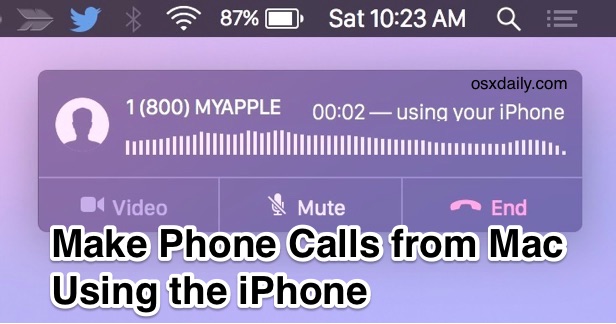
“Why are my iPhone calls ringing on on my Mac?” Perhaps you have asked yourself this question after noticing that since updating your Mac to a modern version of MacOS or Mac (including MacOS Mojave, High Sierra, Sierra, OS X El Capitan, Yosemite), that when your iPhone gets an incoming phone call, so does your Mac. In fact, all of your Macs running the latest Mac OS X and using the same Apple ID will get a phone call, creating a whole chorus of ringing, just from a single iPhone call. While many users will enjoy this feature, which lets you both make and receive phone calls from an iPhone through the Mac by using the computers microphone and speakers, it can also be a nuisance if you’d rather just use your iPhone as a phone. Fortunately, this setting is easily to adjust to suit your preferences.
Apple has released iTunes 12.0.1 for all Mac users, as well as Security Update 2014-005 Mavericks for those running OS X 10.9 Mavericks, and Security Update 2014-005 Mountain Lion for those running 10.8.
Mac users whom have already updated to OS X Yosemite will not find a Security Update available to them, indicating whatever patch is included in the updates for prior versions of OS X has been baked into the OS X 10.10 release.
A notable number of Mac users who have gone to update their machines to OS X Yosemite have discovered something which may seem alarming; the progress bar seems to halt during the installation at just minutes remaining, and in some cases, it can sit unmoving with no apparent progress for well over an hour or two.
Now that OS X Yosemite is available, many users may wish to create a bootable installer drive from something like a USB flash thumb drive or another disk. This allows for several things, the ability to upgrade multiple Macs without having to re-download the installer, the ability to perform a clean install, and also the convenience of having a separate bootable reinstallation drive in the event you need it for serving a Mac.
Apple released the first iMac with an ultra-high resolution Retina display today. The Retina model includes a 27″ display with a whopping 5120 x 2880 pixel resolution, which Apple is calling a Retina 5K display.
Apple has announced updates to the iPad line, officially labeled as the iPad Air 2, and iPad Mini 3. All new models include faster processors and improved capabilities, Touch ID sensors, and while iPad Mini remains in the same enclosure, the iPad Air 2 has been redesigned to be slimmer than ever. Some of these features may not be much of a surprise given that Apple apparently unintentionally leaked some of the details yesterday through iTunes.