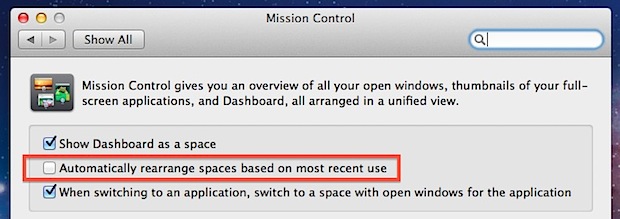
Switching between active Desktops/Spaces in OS X with the three fingered sideways swipe is very quick, but an even faster method is by using the Control keys.
The first option is to use the Control + Arrow keys, which is enabled by default. As you might expect, Control + Left Arrow switches to the desktop Space to the left, Control + Right Arrow goes to the right. Read more »
Rant time! Waking up this morning to 49 new emails from “Apple Support Communities Updates” was less than pleasant, especially considering I had already unsubscribed from all email notifications the night before – or so I thought.
It turns out that you have to unsubscribe to email notifications from each individual thread that you are engaged with on Apple’s Discussion Boards…
Stop Emails from Apple Support Communities Updates
Feels a bit weird to be troubleshooting this, but here’s how to finally shut the email updates off:
Click on any link to get to Apple’s Support Communities and then click on your profile name
Look on the right side for the “Actions” box and click on “Manage email notifications” – yes believe it or not this is separate from the above option to manage your email notifications
Click on each box to check what threads you want to unsubscribe from, or check the topmost box to unsubscribe from all threads you have participated in
Click on the “Remove selected notifications” button
Oddly enough you have to manually unsubscribe for every thread you participate in, so even if you have unsubscribed from other threads in the past but then participate in a new thread, you’ll have to do this again. Read more »
If you’ve used an iPhone or iPad much, you’re undoubtedly familiar with the ‘shake-to-undo’ motion sensing feature that lets you literally shake the device to undo an event or clear a text box. With a little help of a third party tool, we can bring shake to undo to Mac laptops that are equipped with a sudden motion sensor (SMS), mostly MacBook Pro’s and newer unibody MacBooks. The tiny app works by activating Command+Z when movement is detected by the SMS. Read more »
Need to move your iPhoto library? No problem, it’s easily done by a two-step process – first you need to physically move or copy the picture library to the new location, and then you have to tell iPhoto where the new location is. This is all really easy to do on the Mac, and it works to put your iPhoto library onto an alternate volume with more storage, particularly nice if you’re feeling the disk space pinch in OS X.
Let’s jump right to to it and learn how to relocate the iPhoto library. This is basically a two step process; moving or copying the iPhoto library to the new location, and then pointing to that new location from iPhoto app.
Hinting at an impending release of iPhone 5 and anticipating significant demand, Deutsche Telekom has begun to offer reservations for EU customers who are interested in purchasing the next-gen iPhone, whenever it is released.
Bloomberg confirmed that Deutsche Telekom will hand out coupons starting today to reserve the iPhone 5, but didn’t provide any further release details on availability. Deutsche Telekom is Europes largest cellular carrier, and their USA subsidiary is T-Mobile, which has also been rumored to carry the next-gen iPhone.
The news out of Europe comes a day after a report from BGR claims that US retailer Best Buy anticipates taking iPhone 5 pre-orders soon for a launch in the first week of October. This may correspond with the original pre-order reports for the expected iPhone 5 launch sometime in October.
If you’re a Mac user that requires the usage of Internet Explorer under Mac OS X, you’ll find your choices are generally as follows: run IE on top of Mac OS X with Wine which can be slow and buggy, dual boot Windows and Mac OS X which is a nuisance because it requites rebooting, or use virtualization with something like Parallels, VMWare, or VirtualBox. Virtualization is generally the best method because you can run IE and other Windows apps directly atop OS X, but some of the VM software is expensive and you still need a Windows license key, right? Wrong! Read more »
You may find yourself needing to know what the IP address of an iPhone, iPad, or iOS device is. Fortunately getting IP address info is quite easy, and getting an iPhone, iPod touch, or iPads IP address is fairly straight forward, with the instructions being the same for basically all versions of iOS and iPadOS.
Here is what you’ll want to do to find the IP address details in on iPhone and iPad: Read more »
Digging through some of our reader Mac setup submissions, I realized we hadn’t posted a Mac Mini in a while, so here’s one to fill that gap. It’s a 2.6 GHz Core 2 Duo Mac Mini with 4GB of RAM and a 500GB hard drive attached to an external 23″ Acer display, alongside an iPad 2. Elsewhere is an iPhone 4, iPod Shuffle, Apple Remote, and of course the wireless keyboard and Magic Trackpad.
Great Mac setup, thanks to Ed for sending this in a while back!
Feel free to submit your own Mac setup to: osxdailycom@gmail.com
Another iPad competitor is about to enter the stage this holiday season, this time from none other than Amazon. Apparently it’ll just be called “Amazon Kindle”, and while the name isn’t too groundbreaking the preliminary info and specs of the prototype that TechCrunch’s MG Siegler used are quite interesting:
7″ touch screen display
Exterior looks like a Blackberry Playbook (no images have surfaced yet)
6GB of internal storage
Single Core CPU
Wi-Fi equipped
Micro-USB port
Dual speakers
Runs custom forked build of Android OS
Includes a WebKit based web browser, Cover Flow-like user interface to flip through content, a Dock for apps and favorite items
Integrated Amazon access to Amazon Store, Kindle books, music through Amazon Cloud Player, video streaming, and Amazon’s Android Appstore
Free Amazon Prime account with purchase
$250 price point
A few other interesting notes from the TechCrunch scoop: a second 10″ model will probably come out next year in early 2012, possibly with a dual core CPU and some other expanded features, there may be an SD card slot, and Amazon apparently isn’t working with Google whatsoever on the device, despite the fact that it runs a variation of the Android OS and all Android apps will run on the hardware:
Google’s Android Market is nowhere to be found. In fact, no Google app is anywhere to be found. This is Android fully forked. My understanding is that the Kindle OS was built on top of some version of Android prior to 2.2. And Amazon will keep building on top of that of that over time. In other words, this won’t be getting “Honeycomb” or “Ice Cream Sandwich” — or if it does, users will never know it because that will only be the underpinnings of the OS. Any visual changes will be all Amazon.
I’m a big fan of the iPad and of the Kindle, so I’m pretty interested to see what Amazon puts out and how well it runs, and the $250 price point with free Amazon Prime access will be really compelling to a lot of people. Amazon could really be onto something here, but the big question is if they will succeed where so many others have failed in the fight to compete with Apple’s runaway hit, the iPad.
For those that follow along with all the jailbreak stuff and rely on third party Cydia tweaks, the iPhone Dev Team has released redsn0w 0.9.8b7 which is aimed at making the existing iOS 4.3.5 jailbreak easier, but also adding support for jailbreaking iOS 5 beta 6 and beta 7.
What’s the advantage to using redsn0w 0.9.8b7? For 4.3.5 users, you can now perform a tethered jailbreak simply by pointing at the iOS 4.3.5 IPSW rather than 4.3.4. Other than that, the incremental release is primarily aimed at iOS and Cydia devs who are looking to update their apps and tweaks for the latest iOS 5 beta, and the latest beta 7 users still need to point at beta 6 IPSW.
If you’re already jailbroken there isn’t any reason to use this version of redsn0w over past versions.
As usual with redsn0w, you need the appropriate iOS IPSW file for your iPhone, iPad, or iPod touch – either iOS 4.3.5 or iOS 5 beta, and then just follow the simple in-app instructions.
Not much else has changed with the new release, and the jailbreak is tethered, meaning you need to connect the iOS device to a computer and boot the hardware with the assistance of the application.
The Terminal in modern versions of Mac OS X enforces a new monospacing character width standard, which in laymen terms means you no longer have to use monospace fonts in the Terminal. That means you can now use any font you want, even Comic Sans like the screenshot shows down below (hooray?).
The iPhone camera HDR mode takes great pictures, there’s no doubt about that. What might not be so great for some iPhone users is that when you have HDR mode enabled, the iPhone will store two versions of all photos you take into Camera Roll in Photos app, which at 5+ megapixels a pop can quickly consume an iPhones available storage. For some situations, the two photos look so similar that they just look like duplicates, whereas other times either the HDR version or the non-HDR version looks better. Being able to compare the two versions of the photos side by side is undeniably helpful, but if you’re concerned about storage you may want to change this setting so that two pictures aren’t created from a single photo shot with iPhone camera.
The solution is to stop iPhone from saving both the normal and HDR exposures, which instead opts the iPhone to only save the enhanced HDR version to the Photos app Camera Roll. Here’s how to do this in all versions of iOS:
When a new Finder window is opened on the Mac desktop, the user defaults to seeing the new “All My Files” folder, rather than the users home directory. This is a change that arrived with the latest versions of OS X (began in Lion, but continues on through Mavericks), and while it can be useful for those who don’t manage their files, it’s not for everyone. Fortunately, you can change the setting back to the original Mac behavior of opening directly to the users Home Folder. Read more »
Apple has started airing a new iPad 2 commercial focused on learning and education, titled “Learn”, which is appropriate given the fall back-to-school season. The text of the ad is:
Are you curious about new ideas? Do you want to learn a new language? Or just a new word? Maybe you want to know more about anatomy? Or astronomy? You could master something new. Or uncover a hidden talent. There’s never been a better time, to learn.
As usual, the commercial focuses on the user and what you can do with an iPad, which has proven to be a successful advertising format for Apple time and time again.
Are you an AT&T customer? Want 1000 free rollover minutes? Of course you do, all you need to do is send a new text saying “YES” to 11113020. Wait a minute or so, and you’ll get the confirmation:
“Thank you for responding to our free 1000 bonus Rollover Minute offer. You will receive a confirmation message upon validation of this mobile account.”
I sent an SMS and verified this works although it’s not clear when the minutes will be credited to accounts. AT&T has run similar promotions in the past exclusively for iPhone customers, but this one looks like it’s open to all AT&T customers in general, regardless of your phone.
I already have a gazillion rollover minutes but who doesn’t like free stuff? Heads up to iDB for the discovery.
Pushing ever closer to a GM and the final release date in the near future, iOS 5 beta 7 has just been seeded to developers. The newest iOS 5 beta can be downloaded as IPSW from the iOS Dev Center, or more easily, as an Over-the-Air (OTA) update, which can be accessed from iOS 5 beta 6 to download via tapping onto Settings > General > Software Update.
Just as prior updates, Apple recommends you use the “Erase all Contents and Settings” under Settings > General > Reset in order to install the latest beta.
The brief note attached to the OTA update says simply “This beta version of iOS 5 contains bug fixes and improvements.” and refers to the release notes on the iOS Developer Center.
Update: In addition to a new iOS 5 beta, iTunes 10.5 beta 7 and Xcode 4.2 beta 7 were also released.
If you’re one of the many Mac users who uses multiple Macs, say an iMac at home or work, and a MacBook on the go, you should get DropboxAppSync.
This free utility syncs your ~/Library/Application Support/ folder across multiple Macs via the free Dropbox service, allowing you to have the exact same app setups, like preferences, plugins, bookmarks, game files, cache, etc, on all of your Macs, regardless of where you are, as long as you have internet access.
Setup is very simple. Once you have Dropbox configured, quit your open applications, and then just launch DropboxAppSync on the first Mac that you want to be the primary /Application Support/ folder to be synced.
Approve the following message, which informs you that ~/Library/Application Support/ is about to head over to DropBox (via a symbolic link):
This utility will relocate your Application’s support folder to Dropbox. This may be unsupported by the developer! A backup copy of your application’s data will be saved to your desktop just in case…
This utility will save your data to:
Dropbox/Application Support/ApplicationName
If this utility finds your Application data on Dropbox already, it will simply link to the data on Dropbox instead of copying the data over. However, a backup copy will still be saved to your desktop.
Then you run DropboxAppSync on the other Macs, and the app is smart enough to already detect the app data exists so it will simply link to it, syncing your Macs apps.
The developer reminds us that not all apps may support being synced like this, but from user testing there haven’t been many reported issues.
The 2GB free Dropbox account should be adequate for this service with the vast majority of Macs and Mac apps – unless you have Steam games installed like TF2, which store all of their application data in your /Application Support/ folder and causes it to take up a lot of space. For example, without Steam my Application Support folder is about 700MB and I have tons of apps installed, but with Steam it’s well over 25GB. In that case, you’d want to pay for a larger Dropbox account, or just exclude Steam apps from being synced, but it would be an easy way to have all your game data the same on all your Macs rather than manually moving the Steam folder yourself.
Syncing app data across multiple Macs is something that iCloud should do, and hopefully it will in future versions, but in the meantime this is a great free solution.