If you have two directories you need joined together, you can either drag and drop everything together, use the ‘mv’ command to move files manually, or, as we’ll show here, you can quickly merge any two directories within Mac OS X by using the command line tool ditto or ‘cp’.
The command line is generally aimed at advanced users, but ditto is pretty simple to use so almost anyone can use it this way if they’re comfortable with the terminal. Let’s learn how to merge directories with the ditto command on Mac.
A security update has been released for iPhone and iPod touch that stops potentially malicious code from being executed on the devices. Released as iOS 4.0.2, the update is in response to the recent release of JailbreakMe, an extremely easy iPhone jailbreak that is browser based and used the exploit that the update patches.
The description of the problem is described by Apple as follows:
A stack buffer overflow exists in FreeType’s handling of CFF opcodes. Viewing a PDF document with maliciously crafted embedded fonts may allow arbitrary code execution. This issue is addressed through improved bounds checking.
While jailbreaking your iPhone or iPod touch is practically harmless, the potential of a malicious third party attack is of legitimate concern, even if unlikely.
If you have a jailbroken device, you should not install this update quite yet. Likewise, if you want to jailbreak or unlock your iPhone it’s also not a good idea to install the update because there are currently limited jailbreaking and unlock abilities for iOS 4.0.2, with the exception of iPhone 3G which works with ultrasn0w.
Install & Download iOS 4.0.2
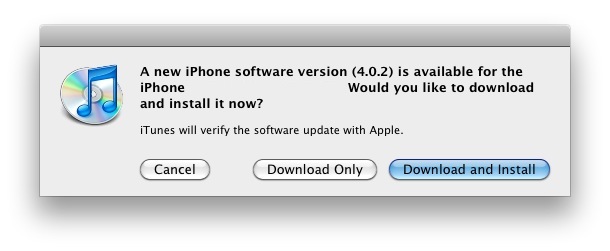
To update and install the iOS 4.0.2 update, all you need to do is plug your iPhone or iPod touch to your computer and click on the “Update” button within iTunes. Then click on the ‘Download and Install’ button and let iTunes handle the rest.
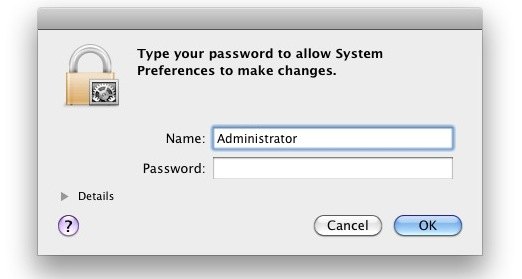
You can easily prevent changes being made on any files or folders in Mac OS X by locking the file or folder in question. This locking capability will also prevent the file or directory from being deleted, since the Trash will not empty while a file is in a locked state.
Locking files and folders in Mac OS X is quite easy, and the process is the same in all versions of the Mac operating system.
You’ll obviously want to know the file(s) or directories you wish to lock down ahead of time, then proceed with the following instructions. Read more »
Are you ready for a Steve Jobs joke? Of course you are! Ok, so this joke is a little corny, but who cares, because sometimes corny is good for a laugh, right?! OK here we go:
Thank you to Eric for sending this in. I’m not sure if Eric is the originator of this one or if it’s from someone else, but if you know of any other Steve Jobs or Apple jokes, feel free to put them into our comments.
So you forgot your Mac password… uh oh. Don’t worry, it happens and you aren’t out of luck. You’ll need to reset the forgotten password and there’s several ways to do this, we’ll focus on the three best methods; the first is dirt simple and will utilize the Apple ID (yes, the same on you use for iTunes and App Store purchases), the second method is a hack of sorts and does not require a Mac OS X recovery drive or CD and is guaranteed to be effective, and the third trick is fairly simple but it requires either a Mac OS X DVD, boot disk, or Recovery mode partition to use. Use whichever method works for your situation, but whichever method you choose you will have your password reset and gain access to your stuff again.
If you need to know what version of iPhone baseband and firmware your device is running, you can find the information directly on your iPhone quickly and with little effort.
Here’s what you’ll want to do to check the iPhone firmware and/or baseband versions.
In some situations, you may need to repair a Macs disk permissions but be unable to access the Disk Utility app, perhaps due to remote management or because of a problem with something in OS X. Fortunately there’s another method you can use to repair disk permissions in Mac OS X, accessible through the command line.
To be clear, this will initiate the exact same Repair Disk Permissions functionality that is seen in OS X Disk Utility app, via the Terminal. Launch the Terminal.app and then just type the following command:
As the tech world froths with more iPhone on Verizon rumors, an overlooked bit of information caught my eye. According to Digitimes, Apple is going to replace the glass back panel of the iPhone 4 with metal that features an integrated antenna:
As for the CDMA iPhone, Pegatron Technology is expected to start mass production in December and will supply to both US-based Verizon Wireless and China-based China Telecom. The CDMA iPhone’s back plate will be forged from metal materials and will feature an integrated antenna, according to Digitimes Research.
While the report specifically mentions the CDMA iPhone (Verizon is CDMA), it would be unusual if Apple kept other iPhone 4 models with a glass enclosure. My guess is that Apple is looking to replace the back glass for two reasons: one, it’s relatively fragile and prone to shattering with minor drops, and two a metallic back panel with integrated antenna could help to aid the antenna problems that have received so much negative press.
I really wouldn’t be surprised if Apple restyled iPhone with a metallic enclosure. From a purely design standpoint it seemed unusual that Apple went with the glass back considering their other products are enclosed in a hardy and attractive aluminum shell. Assuming they figured out a way to help the antenna issues and just make the device more durable in general, this design change is a no brainer before the iPhone comes to millions more customers through Verizon and even T-Mobile in the USA.
All iPhones have a baseband, and iPhone baseband is essentially the cellular modem firmware that is on your iPhone. Specifically, baseband includes the low level software that is running on the iPhones cellular modem hardware, the combination of which allows the iPhone to connect to a cellular network to send and receive data, phone calls, and transmissions.
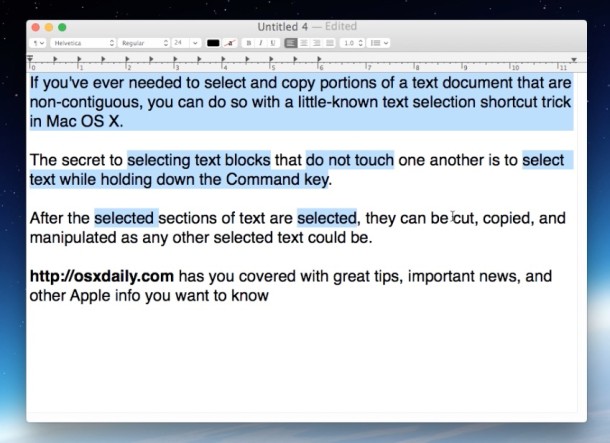
If you’ve ever needed to select and copy portions of a text document that are non-contiguous, in other words, sentences or words that are not right next to one another and do not touch, you can do so with a little-known text selection shortcut trick in Mac OS X.
It’s no secret that I’m basically a Starcraft 2 addict, whether it’s multiplayer or singleplayer doesn’t even matter I just love playing the game. Of course it’s also fun to get a little extra help in the form of some cheat codes, so here is the complete list for SC2. These cheat codes work for either PC or Mac versions of Starcraft 2.
Starcraft 2 Cheat Codes
You activate the cheat codes within Starcraft 2 by hitting the Enter or Return key and then typing the cheat and hitting return/enter again to enable it. You will get a notification saying the cheat is active and letting you know that achievements are disabled (see note below).
God Mode – terribleterribledamage
Create Units at No Cost – moredotsmoredots
5 Billion Credits – whysoserious
5000 Vespene Gas – realmendrilldeep
Unlimited Energy – jaynestown
Upgrade Weapons, Armor, and Shields – iamironman
Disable Ability Cooldown – hansshotfirst
Disable Tech Requirements – sosayweall
Disable Victory Conditions – tyushasleftthegame
Play “Terran up the Night” Song – overengineeredcodpiece
Cinematics Menu – eyesofsauron
Remember that cheats only work in Single Player, either in Custom Games, Tutorial, Campaign, or any other Single Player mode.
Starcraft 2 Cheats Disable Achievements
This is very important to note; if you use cheat codes in Starcraft 2 you will lose your ability to earn achievements while the cheat is activated for that game. This is the message you will see:
“CHEAT PlayerName Achievements have been disabled due to cheat usage. To enable achievements again, start a new game or load a saved game.”
You then need to either start a new game or load a previously saved game to get achievement unlocking back again.
The cinematics cheat can cause Starcraft 2 clients to randomly crash which is likely part of the wider bugs but the framerate cap listed on the Starcraft 2 bugs and fixes page seems to help.
Anytime you are connected to a local area network (LAN) you’ll be assigned an IP address for that network, and often it’s important to know what this IP address is.
There are two quick ways to get your LAN IP address in Mac OS X, one is more user friendly using the GUI, and the other is through the command line, we’ll show you how to do both.
Alright gamers, fire up iTunes and the App Store because for a limited time the Civilization for iPhone app is free. No this isn’t the trial lite version, it’s the full Civilization Revolution, which usually sells for $6.99. The game is being given away for free courtesy of the FreeAppADay program, but there’s nothing to sign up to get the game.
Civilization Revolution is the iPhone version of the Sid Meier Civilization dynasty, where the objective is to build an empire, discover the in-game world, and conquer all to eventually rule the world. It’s a really fun turn-based strategy game and well worth a download even at $6.99, so being free is an absolute steal and comes highly recommended.
I’m always looking for good mobile games and Civilization Revolution fits the bill well when I’m (temporarily) pulled away from my current addiction of Starcraft 2.
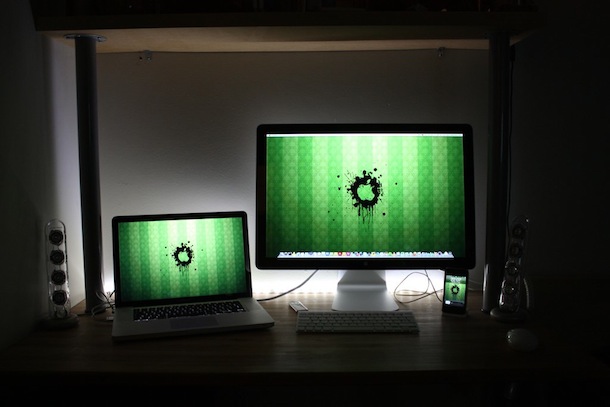
The Apple Cinema Displays aren’t cheap but they certainly are gorgeous. Here one sits beautifully alongside a 15″ MacBook Pro, and a iPhone. Only thing he needs is a stand for the MacBook Pro.
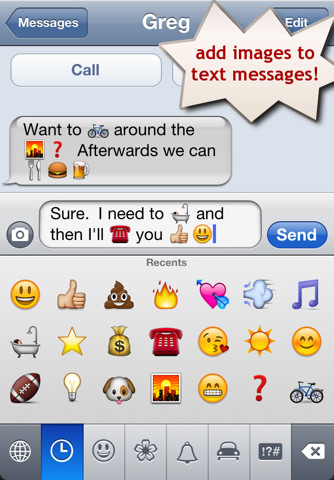
While new iPhone and iPads have the Emoji keyboard built in to iOS and ready to be enabled, older devices may not. But if your iPhone, iPad, or iPod touch does not have the Emoji keyboard available because it’s running an older version of iOS (like iOS 5 or older), you can still use Emojicons by downloading an app that offers the same Emoji keyboard.
Yes, older iPhones need to download an app to get emoji, but this app works for older models that do not support that native emoticon character set.
Old-model iPhone and ipad owners, do not worry, you can still use the popular emoji icons on older iPhone models without a jailbreak thanks to a free app available at the app store. We’ll show you what to do, it’s easy.
This is impressive: 70% of new college students are bringing Macs with them to school, according to a Global Equities Research analyst Trip Chowdhry. The figure comes in relation to his downgrading of Microsofts stock, which caused shares of the software giant to fall 2%. Here are the details:
70 percent of college freshman are entering school with Macs, up about 10 percent to 15 percent from a year ago.
“Our research is indicating that Microsoft is unable to connect with the new generation of users,” Chowdhry wrote, adding that this could cause problems down the road when these students enter the work force and once again pick Macs over Windows.
I hope the raw statistics and research data is released so we can get the precise details, but speaking from experience I can definitely say that Macs and Apple hardware are overwhelming college campuses. Sure you’ll see other computers and electronics around too but a clear majority of people are using at least one of Apple’s signature products, whether it’s a Mac, iPhone, iPod, or iPad.
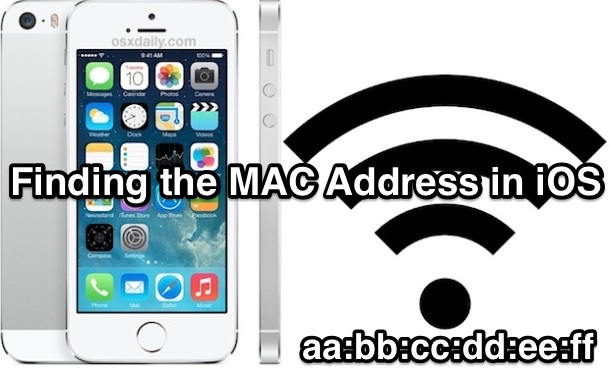
All iPhone devices have a unique hardware identifier known as a MAC address, or as iOS refers to it, a Wi-Fi Address. Sometimes you need to know what the iPhone MAC address is so that you can connect an iOS device to a specific router, provide it to a systems or network administrator, using Wake On LAN, or for many other purposes.
If your Mac is suddenly running sluggish and you launched Activity Monitor, you may notice a process named ‘mds’ cranking away at 30% and even up to 90% CPU utilization. If you see this, don’t worry, it’s not abnormal behavior and your Mac isn’t crashing, it’s just indexing it’s built in search engine.
What is MDS in Mac OS?
mds stands for “metadata server” and the mds process is part of Spotlight, the amazingly powerful and very useful search feature built directly into the foundation of Mac OS X. You access Spotlight by hitting Command+Spacebar.
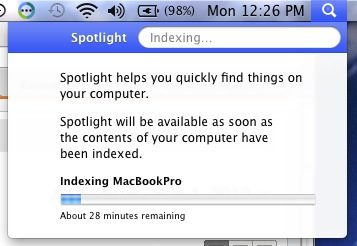
An easy way to identify that mds and Spotlight is indexing is to look at the Spotlight icon in the upper right corner of your menubar, when Spotlight is indexing the magnifying glass will have a dot in the center like so:
You can then click on the Spotlight icon and you’ll see your main hard drive being indexed, with a progress bar and estimated time until completion:
Is the mds process related to mdworker?
Yes. Usually you will see the mds process in conjunction with mdworker, which is another part of Spotlight and it’s indexing engine.
How long does mds & Spotlight take to finish indexing?
How long it takes to update the Spotlight index depends on a few variables, but mostly the size of your hard drive, the amount of data being indexed, major changes to the filesystem, and the time since last indexing. Just let the indexing complete, it generally takes between 15 and 45 minutes to complete.
If Spotlight isn’t working, you can check out these Spotlight troubleshooting tips which will get you situated again. If you don’t ever use the search feature or just don’t like it, you can also disable Spotlight and all of its indexing.







 As the tech world froths with more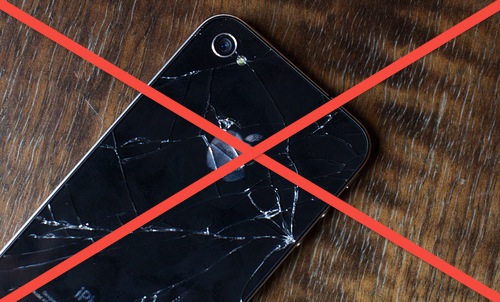


 addict, whether it’s multiplayer or singleplayer doesn’t even matter I just love playing the game. Of course it’s also fun to get a little extra help in the form of some cheat codes, so here is the complete list for SC2. These cheat codes work for either PC or Mac versions of Starcraft 2.
 Anytime you are connected to a local area network (LAN) you’ll be assigned an IP address for that network, and often it’s important to know what this IP address is.
  Alright gamers, fire up iTunes and the App Store because for a limited time the Civilization for iPhone app is free. No this isn’t the trial lite version, it’s the full Civilization Revolution, which usually sells for $6.99. The game is being given away for free courtesy of the FreeAppADay program, but there’s nothing to sign up to get the game.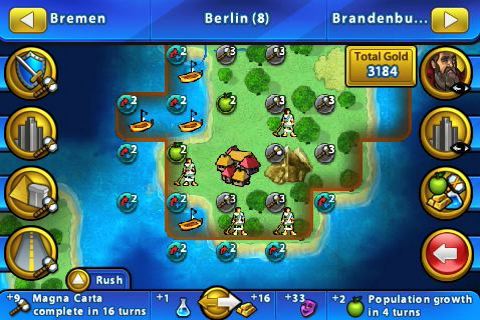
 .
. While new iPhone and iPads have the